An AI-friendly web, the Äventyret way
How we build a web where both people and AI services get the right answer, and where you can always show where that answer comes from.
Ask an AI service what the rules are and you get an answer in a second. Fast, well-phrased and confident. But is it correct?
An AI-friendly website is one where the answer to that question is yes. The content is structured, owned and current enough that both people and AI services can understand it, reproduce it accurately and use it to guide. And whoever stands behind the website can always show where an answer comes from and who stands behind it. It sounds like technology, but it is mostly about content and responsibility.
The principles apply to anyone with a website, companies as much as public agencies. To make it concrete we still use a public agency as our example, because the requirements are strictest there: the answers must be correct, traceable to a legal basis and work for everyone. A company can take a freer approach and pick what fits. The questions are the same.
The same thing in five places
You probably recognise it. The same piece of information lives on the website, in a PDF from 2019, in the chatbot's knowledge base and in the support texts used by customer service. Someone updates the website, and the PDF stays behind. Sooner or later the copies say different things.
You might notice the inconsistency and call or email to ask what applies. An AI service does not call, and does not email. It picks one version and delivers it as confidently as a weather forecast, with the agency as its source. Then the answer spreads further.
For a public agency it is more than a communication problem. An incorrect AI answer built on an agency's information can have serious consequences. Someone misses a deadline and loses the right to appeal. Someone pays the wrong amount. Someone fails to claim a benefit they are entitled to. Correctness is a matter of legal certainty and trust.
The chatbot is not the fix
Launching a chatbot is an obvious move. ”Ask our AI assistant!” But a chatbot built on unclear, contradictory or outdated content does not correct the errors. It amplifies them, now with a friendly tone and the agency's logo.
It is the content and its governance that make a website AI-friendly. Every piece of information must be traceable to an accountable owner and, where needed, to a legal basis. At Äventyret we tend to sum it up in two rules: one question, one answer, one owner. And no owner, no publication.
Two more things belong in the picture. The web has to work for everyone. Whether or not you prompt your way to the information, the website should be at least as good for the person who reads it themselves, uses a screen reader or needs plain language. And the machines are already here. Companies submit information from system to system, often through agents and accounting firms. They are, in practice, the agency's first machine users, and have been for a long time.
One source, many windows
Äventyret's approach is for the agency to gather its knowledge in one shared source that it owns itself. There it holds structured knowledge about what applies and structured processes that describe how things are done. The website becomes one of several windows onto the source, alongside the agency's own chatbot and guidance, the support used by customer service, open interfaces and external AI services.
When something changes, it changes once. And it is right everywhere.
The source does not have to be a new system. It is about how the content is structured, owned and maintained, and it should work regardless of platform. In short: the agency decides over its own knowledge, its processes and its data, whatever AI services and vendors it uses. That is what we call sovereignty. The AI services come and go. The source stays.
The smallest possible answer
The building block is the answer unit: the smallest answer that can be understood on its own, to a question users actually ask. You find the questions in search logs, customer service cases, chat logs and user interviews. Not in the org chart.
The answer comes first. The heading is the question, the first sentence is the answer, and then follow explanation, conditions and exceptions. Many texts start from the other end, with the background. The conditions sit in the same unit as the answer, because AI services readily lift out individual paragraphs while people read in context. Plain language must never drop a condition.
Every answer also carries information about itself: who owns it, who has reviewed it, what it rests on and how long it applies. A little like the best-before date on the milk, but with an accountable publisher. In full it covers owner, subject reviewer, legal basis, audience, validity, last and next review, status and version. The information is visible both to people (”Last reviewed …”) and to machines.
The units are connected. Concepts link to rules, rules to processes, processes to services and new versions to the ones they replace. Then an AI service can follow the chain from question to legal basis, and the agency sees immediately what is affected when something changes. Language versions, plain language and sign language are variants of the same unit, with the same owner and validity. When the original changes, the variants are flagged, so that no version is left behind with old information.
Here is what an answer unit can look like, using the question of how long you have to appeal a decision as an example.
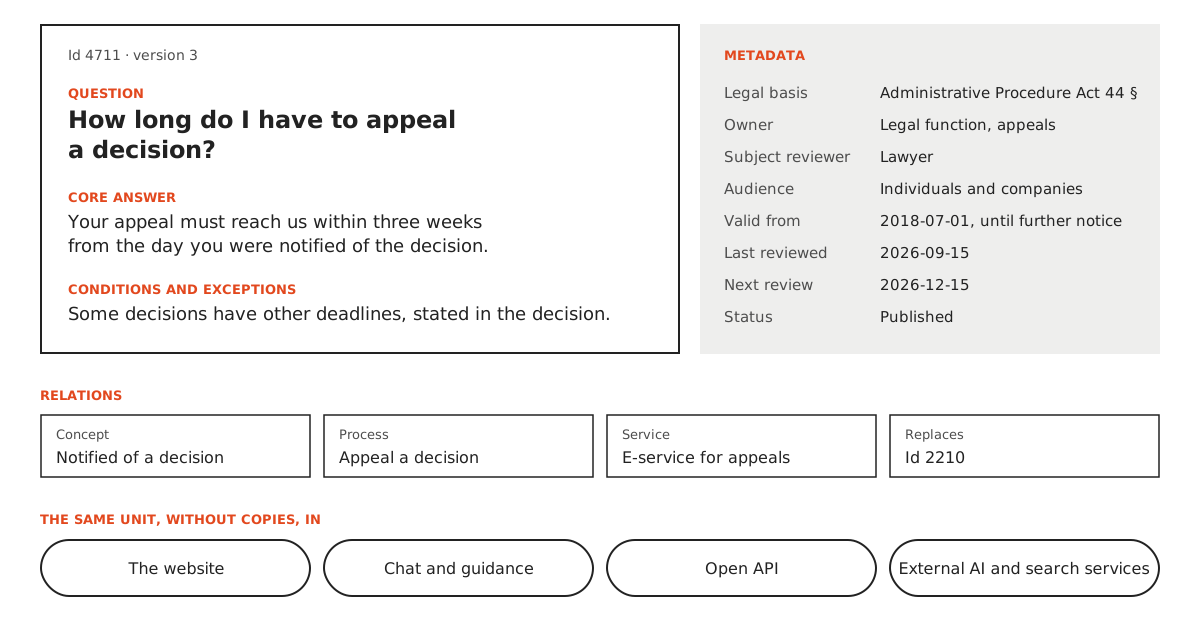
One answer, one owner, many channels. An example of an answer unit: the smallest answer that can be understood on its own.
The same unit is then used in four ways, without being copied:
- The website. The units are assembled into readable pages in semantic HTML. Everything important must be present in the page itself as it comes from the server. Most AI services' crawlers, such as GPTBot, OAI-SearchBot, ClaudeBot and PerplexityBot, do not run JavaScript and therefore do not see content that only loads in the browser. Google is the exception.
- Structured data. Markup following schema.org helps machines interpret the page. It still matters less for visibility than the content itself being clear.
- Open interface (API). The units with metadata, validity and source, following Digg's REST API profile, for the agency's own services and others'.
- Chat, guidance and customer service. Only approved and valid units, always with a source reference.
Processes are content too
Much of what sits on an agency's website really describes a process. How you apply, report, change or appeal. So we describe processes as models: steps, roles, conditions, decision points, supporting documents, deadlines and statuses, in open standards for flows and decision rules (BPMN and DMN). Each step refers to the answer units instead of repeating them.
The image shows what it can look like, with an ordinary building permit built in a process builder we have developed. The phases read from left to right, and every step, decision and document has its own id.
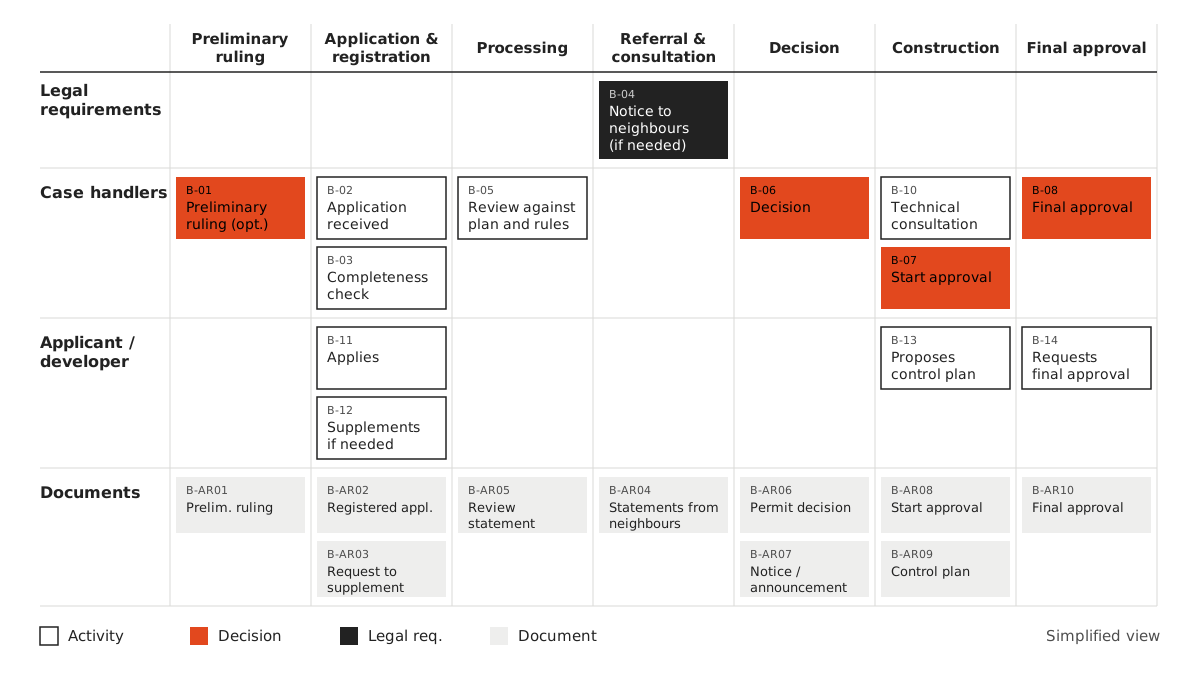
A process as a model, not as running text. Example: an ordinary building permit, built in a process builder where processes become executable by both human and machine users. The visualisation is simplified. When a process becomes real we bring in experts, in this case on building permits.
Each type of step, such as submitting information, attaching documents or receiving a ruling, gets its own standardised and accessible interface pattern. The human meets the same logic the AI service follows, and new processes are built from proven parts.
Processes often change while cases are ongoing. So each process version has a number and a validity period, and each case is tied to the version it started in. That way it is always possible to show what a decision was based on.
When Google, AI and the reader want different things
The good news first. Search engine optimisation (SEO), answer optimisation (AEO or GEO, content that answers the question directly enough to be lifted into search and AI answers) and usability rest largely on the same ground: clear headings, semantic HTML, plain language, alt texts and important information as text on the page rather than in PDFs. Accessibility is already a legal requirement and at the same time makes the content easier for machines to interpret. That is where we begin.
Sometimes the goals still pull in different directions:
- Standalone answer or context? AI services lift out paragraphs, people read in context. We write each answer so that it stands on its own and then assemble the answers into readable pages. We never write separate texts for AI.
- Many pages or fewer and better? Near-identical pages can yield more search hits, but they give AI services contradictory answers, and the search services devalue mass-produced content. One question, one answer, one owner.
- Simple or complete? The core answer first, conditions and exceptions right after, the legal basis linked.
- Visibility or control? The AI vendors have separate crawlers for search, for fetches the user asks for, and for training, and you control them separately in robots.txt. OpenAI, for example, has OAI-SearchBot for search, ChatGPT-User for the user's fetches and GPTBot for training. Block OAI-SearchBot and you disappear from ChatGPT's search answers, while blocking only GPTBot leaves you as visible as before. Crawlers that fetch on the user's request, however, do not always obey robots.txt. In the same way, Google-Extended controls the training of Gemini but does not remove the site from Google's AI overviews. If you want to appear in AI answers, you allow search and user requests. Training is a separate question of principle.
And if a conflict still remains? Then a fixed order applies. The accessibility requirements are a floor that is never lowered. Above that, correctness comes before usability, and usability before visibility.
One thing that often comes up in these conversations is llms.txt, a file meant to help AI services find their way around the site. Google has said explicitly that it does not affect search, either way, and none of the big AI search services has confirmed that they use it. It can still be worth generating from the source ahead of step three, as a simple map for agents. But it is not a visibility measure, and anyone selling it as one has misunderstood something.
No owner, no publication
Responsibility for the content sits in the operations, not with the web editors. The content owner, a manager or function in the operations, makes sure the content is correct and current and decides on publication, change and retirement. The subject reviewer, for example a lawyer, checks that it is legally and factually correct. The editor is responsible for plain language, accessibility, structure and metadata, and publishes. The information manager holds the model, the glossary and the test questions together and follows up.
How often an answer is reviewed depends on the risk: how many people use it and what an error could lead to. Deadlines and amounts are reviewed more often than other things, and overdue reviews are flagged to the owner.
Much of the monitoring can be handled by AI agents. They track changes in statutes and decisions, find contradictions and duplicates, flag dates that are about to expire and write first drafts in plain language. But they never decide and never publish on their own. The agents propose, people decide.
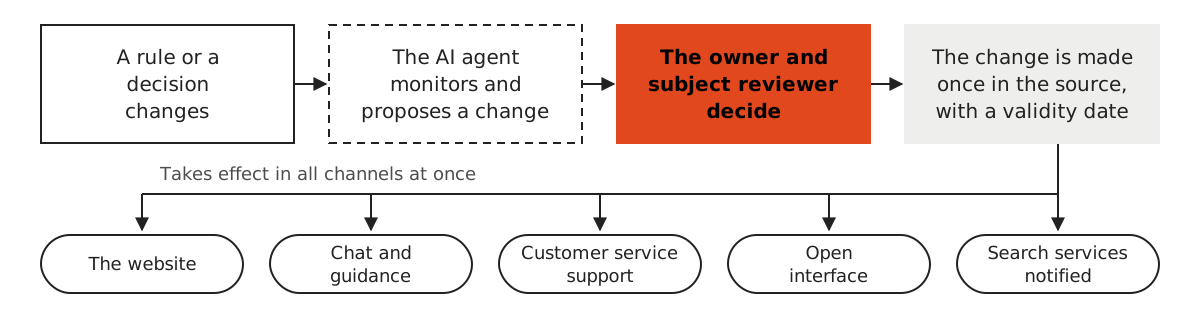
A change is made once and takes effect everywhere. The agents monitor and propose, people decide.
Errors are corrected quickly, and at the source. Every answer on the website and in the chat has a way to report an error, and the reports go straight to the owner. Errors in deadlines, amounts and other legally decisive information are corrected the same day, and the cause is followed up so that the error does not come back.
And nothing disappears quietly. An answer that is retired gets a status and an end date, and ”replaced by” points onward. Old addresses lead to the new answer or clearly show that the content has been retired. The answer is removed from the chatbot's source material the same day and the search services are notified. The old version is kept, so that it is possible to show what the agency said at a given point in time.
Your own and others' AI services
An AI service the agency puts into use itself, built in-house or procured, speaks with the agency's voice. So it is governed by a secured source and clear rules. It is built to answer only from approved and valid units, to show source and date and to stay within the agency's domains. It never rules on individual cases, refers to a case handler when needed and is instructed to rather say it does not know than to guess. And it is clearly marked as an AI, in line with the AI Act's transparency requirements.
The knowledge is not trained into the model. A trained model cannot be updated the same day a rule changes, and it cannot show where an answer comes from. Instead the service fetches the answer from the source every time someone asks, what is usually called RAG (retrieval-augmented generation). Here the answer units make a big difference. When each unit is already a standalone answer with its conditions, the service fetches the whole answer, not a paragraph torn out of context.
But even with the right material a language model can phrase things wrong. So a fixed set of common and critical test questions probes the answers before launch and after major changes. The service is also tested against attempts to trick it outside its rules, so-called prompt injection.
The agency cannot control others' AI services. But it has a natural advantage: it is the most authoritative source on its own questions. The advantage only counts if the source can be found and is unambiguous. Otherwise the AI services cite second-hand sources that are rarely updated. So get rid of contradictory duplicates, let PDF and print versions point to the website as the original, and notify the search services of changes the same day. To Bing you can do this directly via the IndexNow protocol, and it matters more than you might think: Bing's index is used by Copilot and lies largely behind ChatGPT's search. Google does not support IndexNow; there, updated sitemaps apply instead. The test questions show where the services answer wrong, so that the source can be clarified.
Sovereignty also applies to data. The website is public, but what people write in a chat often contains personal data, and at a public agency the questions are normally public records. Your own AI services should therefore run where the agency decides where data is processed and how long it is kept, and where questions and answers are not used to train models. Because the source is built on open standards, the agency can switch AI model, including to open models, without being locked in with a vendor.
How you know it works
The goals are set before anything is changed. Otherwise it is never possible to show what the work achieved. The levels in the table are our starting points, and they are fixed only once the current state is measured. A goal without a current state is a guess.
| Goal | How we measure | Starting point for the target level |
|---|---|---|
| Correct answers | A few hundred common and critical questions are run each month against the agency's own chatbot and the largest AI services. AI services do not answer the same way every time, so each question is run several times. The information manager assesses the answers and the subject reviewer settles doubtful cases. | At least 95 percent correct answers with the right source in the agency's own chatbot. A rising share in external services. |
| Visibility in AI answers | The share of test questions where the agency is named as the source, complemented by the search services' own reports on AI answers. | An increase against the current state at each half-yearly follow-up. |
| Current content | The share of content with an owner, a validity date and a review on time. Time from a decided change to the right answer in all channels. | 100 percent in the pilot area. Right the same day the change takes effect. |
| Accessibility and plain language | WCAG 2.2 level AA, one step above today's requirement (2.1 AA), plain language per the Language Act and user testing. | No known defects at level A and AA at publication. |
| The user completes their task | The share who solve their task in user testing. Fewer contacts with customer service on questions the website already answers. | At least 90 percent in the pilot area's tests. |
Visibility can now be followed in the search services' own tools. Since early 2026 Bing Webmaster Tools has had a report, still in preview, that shows how often the content is cited in Copilot and Bing's AI answers, and which search phrases the AI itself used to find it. Google Search Console is rolling out a corresponding report for AI overviews and AI Mode. The tools do not show everything, but together with the test questions they give an honest picture of where the agency stands.
Where it leads: readable, guiding, executable
We see the work as a staircase in three steps. Each step is useful in itself and lays the ground for the next.
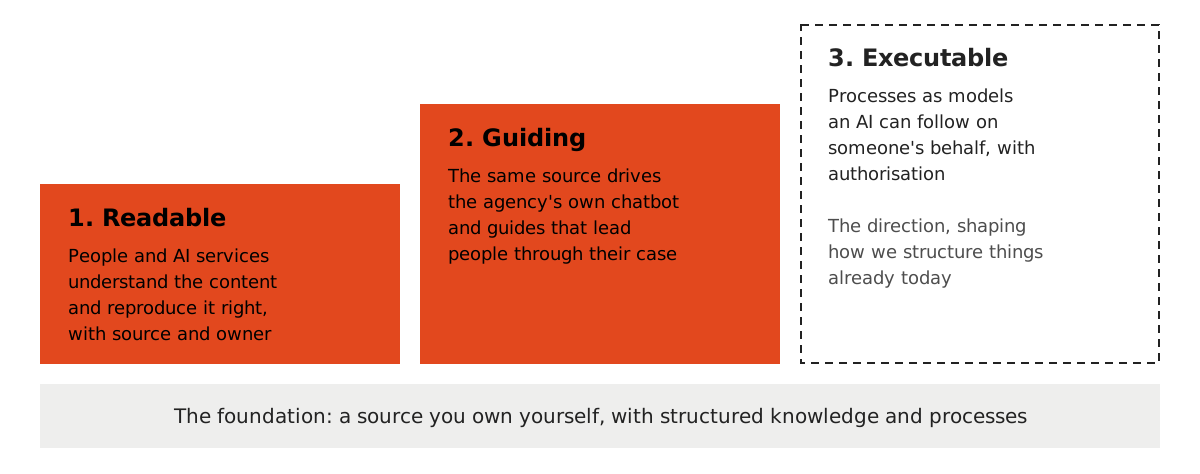
Each step is useful in itself and lays the ground for the next. From readable to guiding and, in time, executable.
Step three makes the agency ready for what is often called the agentic web. There, AI assistants carry out tasks for people instead of just answering questions. Imagine a business owner who asks their AI assistant to appeal a decision. If the process exists as a machine-readable model, and can be reached through an open interface, the assistant does not have to guess. Such an interface can be built, for example, with MCP (Model Context Protocol), which many AI assistants use today to call services. It can check the deadline, gather the right documents and submit correctly, with authorisation from the business owner and traceability for the agency. Legally it is still the business owner who acts, and the assistant is their tool.
An agency that is ready for agents does not, then, build agents of its own. It makes sure that rules and processes can be followed correctly even when an AI does it on someone's behalf. Identity and authorisations are handled with e-identification. For public agencies, SverigeID is added, the state e-identification launching on 1 December 2026 and set to be part of the state digital identity wallet. Further ahead there will also be the business wallet the EU has proposed. In both cases you hand over only the information that is needed. Step three is the direction, and it shapes how we structure things already today.
Where do you start?
With ownership, not technology. An answer without an owner is not published.
Measure before you change. Run a few hundred common and critical questions against your own chatbot and the largest AI services, so that you know where you stand. Start where the value and the risk are greatest, with the content that is used most and where errors have the biggest consequences, preferably in a bounded pilot area with a stable legal basis. And use what already exists: content, platform and concepts.
Here is what a typical setup looks like. First a pre-study where we inventory content and ownership, analyse real questions from private individuals, companies and agents, measure the current state and choose a pilot. In parallel we develop the model for content and governance together with the operations. Then a pilot where a bounded area is rewritten into answer units, a process is modelled and the path of a change is tested for real. Together it takes about six months. After the pre-study and after the pilot, management decides whether to go on, based on the measured effect. After that the remaining areas are moved over one at a time, until the agency manages on its own.
What you get is, first and foremost, not a new website. It is a source that you own yourself and that both people and AI can trust. The website becomes one of the windows onto it.
We already work this way
This is not just an idea. For a regional public administration, Äventyret has made the processes for grant applications executable. For an international private equity firm we have done the same with the processes for the entire business. And for an industry body that provides legal advice we have developed content principles, a governance model and a search that today drives an AI assistant in live operation.
At the same time we are developing, together with municipalities and regions and in dialogue with national agencies, a general model for executable public processes. The process builder in the image above is part of that work. We are also expert consultants at EU level on process governance in the public sector.
Äventyret also uses AI agents in our own work. In content work they help with inventory, the first rewrite into answer units and running the test questions. In technical production, when we build websites, services and integrations, the developers work with AI agents that write, review and test code. The same rule applies everywhere, for us as for our clients: the agent proposes, the human decides. It makes the work faster without moving the responsibility.
Want help from people who have already done this? Call or email us. You can, after all, unlike an AI service.
The details about AI services and search tools in this text apply in autumn 2026, when this article was published. This area changes quickly.