Liljewall Arkitekter: needs before technology
From pre-study to launch: a new intranet for Liljewall's 250 employees, with AI search, their own assistants and an academy for all continuing education.
Liljewall Arkitekter's intranet was the hub of the working day for some 250 employees, but it had reached its limits functionally, editorially and technically. Äventyret was first asked to establish what the needs actually were, then to test the technology, and finally to build. The result launched in June 2026: an intranet with AI search, their own assistants and a place for the knowledge and culture that previously had nowhere to go.
About Liljewall Arkitekter
Liljewall Arkitekter is one of Sweden's larger architecture practices, with some 250 employees in Gothenburg, Stockholm and Malmö. The work is knowledge-intensive, project-based and marked by a high degree of independence in everyday work.
The challenge
An intranet that people use is harder to rebuild than one nobody opens, because you first have to know what is worth keeping. So Liljewall did not ask us for a new system. They asked for an investigation into what the needs were and which technical paths could meet them.
The interviews
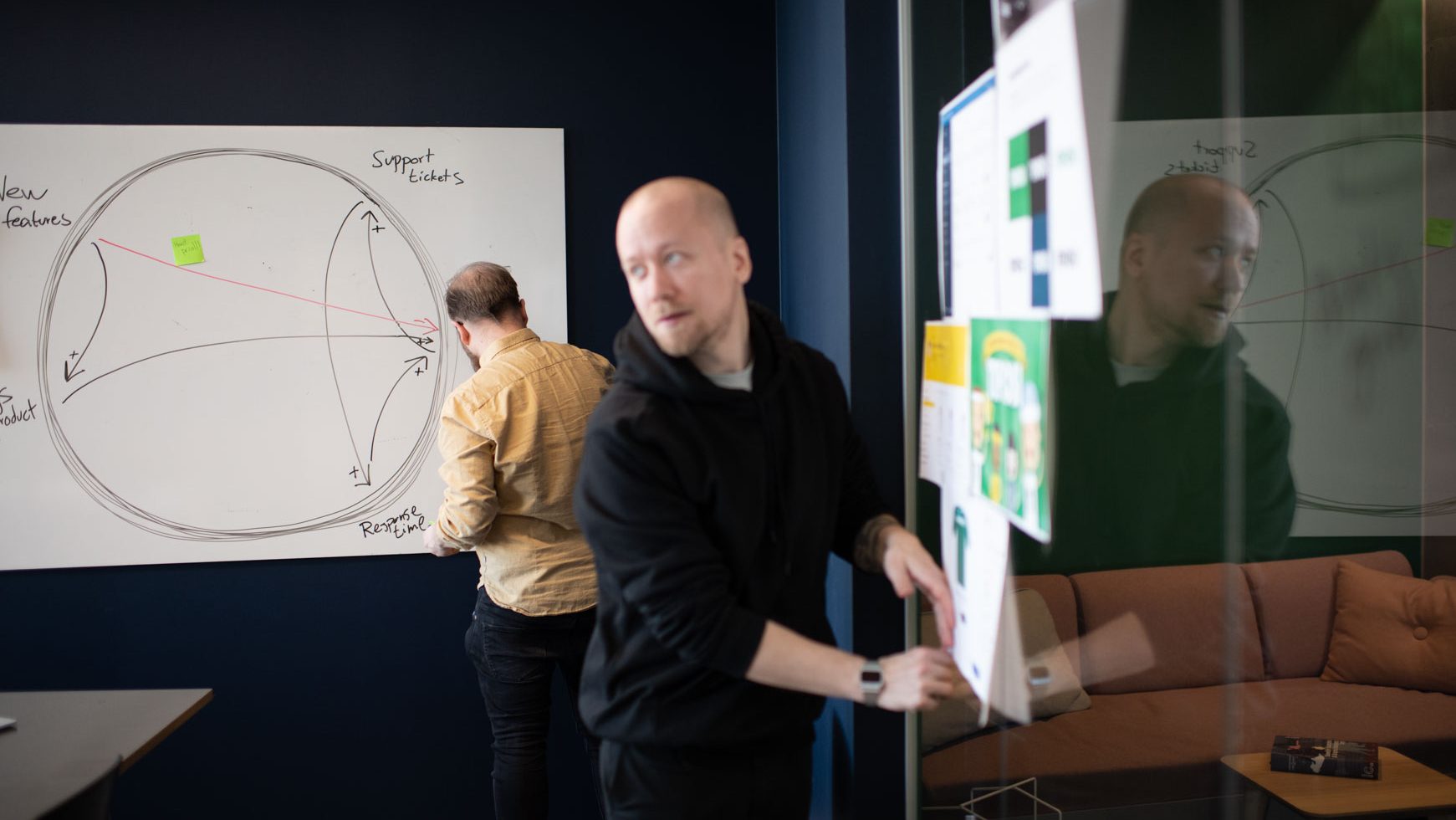
We began with in-depth interviews with five employees in different roles, with different lengths of service and different responsibilities. The selection was deliberately broad, because an intranet for the whole organisation cannot be shaped around a single profession.
We asked as carefully about what worked as about what chafed, since the former risked being lost in a rebuild. Everything was gathered in one place, the order of the menu worked as a learning path for new starters, and the link to the management system and project methodology made the intranet a quality tool rather than a noticeboard.
For visitors, it was orientation that failed. The search could not be trusted, intermediate steps in the navigation left a gap between the click and the content, and it was unclear what was private and what everyone could see. For editors, it was the work itself that held them back. A small change took a large effort, and permissions were so narrowly set that editors became bottlenecks for other departments' content.
There was also something missing that had nothing to do with finding things. Several people asked for inspiration and a sense of what was happening at the other offices, but the news feed was reserved for what concerned all three. A great deal of accumulated knowledge, such as recorded walkthroughs and filmed internal courses, was also buried so deep that in practice it disappeared.
The problem was not where it showed
The visitors' problems were the visible ones. The editors' problems were the cause.
An intranet does not go out of date because someone decides it should, but because updating it costs too much. When changing a heading takes half a day and every department has to go through an editor, neglected content becomes the normal outcome, however good the interface looks to the reader. A new interface would have hidden that for a while. What was needed was to change what it costs to keep content alive, and that is a question of ownership at least as much as of design.
The core needs
The interviews were distilled into core needs, formulated without any technology in them, so that the choice of technology could later be tested against them rather than the other way round.
Find
The right information quickly and reliably, without needing to know where it happens to be
Relevant
Understand what applies to me, in my role, right now
Simple
Navigate just as easily regardless of technical confidence
Grounded
Content that reflects how Liljewall actually works, not just what is formally correct
Reliable
An intranet you can trust, in both function and content
Three directions
Based on the core needs, we set out three directions. The first, Smart Hub, makes the intranet a hub in the working day, where it is clear where to turn for what you need. The second, an integrated platform, brings in more systems, so that for example time reporting and leave requests are handled directly in the intranet. The third, AI-assistant first, lets an assistant take the place of the menu as the main way in.
Liljewall chose Smart Hub, with the AI assistants as the next step. We advised against the integrated platform, because at that stage it would have become more technically complicated than valuable.
Custom-built or off-the-shelf
Only then was custom-built weighed against an off-the-shelf service. We compared five intranet services, weighing cost over three years, support for search and AI, integration options, further development and maintenance. Services and CMSs that store data outside the EU were ruled out straight away.
The recommendation was a focused solution of its own: WordPress as the editorial tool and a Next.js frontend, built to reuse Liljewall's existing sign-in through Entra ID and the documents in SharePoint, with custom development only where those fall short. It was the second time we chose the smaller option over the larger one. Before the build began, we tested it in a technical proof of concept in autumn 2025, which showed that the sign-in, SharePoint and Liljewall's AI platform could be connected. That decided how large the project needed to be.
AI support the organisation owns itself
That same autumn, Liljewall started its assistant track, on an AI platform with permission controls and a connection to SharePoint. We supported the start and created a dedicated place in the intranet where the assistants are presented. Permission controls were a requirement from the outset: an assistant that answers from documents the user has no access to is a security problem, not a feature.
Today there is a shared assistant for the intranet's content and knowledge and a large number of specialist assistants for the organisation's varied needs, and Liljewall administers them itself. The assistants are only as good as the content they rest on, which made structure and ownership a precondition rather than an afterthought.
The concept
Before anything was drawn, we formulated a concept. Not a list of requirements, but a framework for the decisions to come. At its core was a platform that makes it easy to find, understand and use shared knowledge, and that feels so good people want to be there.

Katarina Morén Styf
Chief Marketing Director, Liljewall Arkitekter
The structure
The structure that followed changed the question. Instead of which department owns something, the entry points start from what you need to do. With it comes the real answer to the editorial friction: a designated content owner for each area, a shared page template, and tagging by office, role and subject so that content can be directed where it belongs.
Documents follow the same logic. SharePoint is the source, the intranet is the hub. Files and their versions stay where they already live, and the intranet links to them without duplicating them. A policy is likewise a stable page with an owner and a version, and when it changes, a short update is created instead and appears in the feed. The source stays put, the notice moves.
A search you can trust
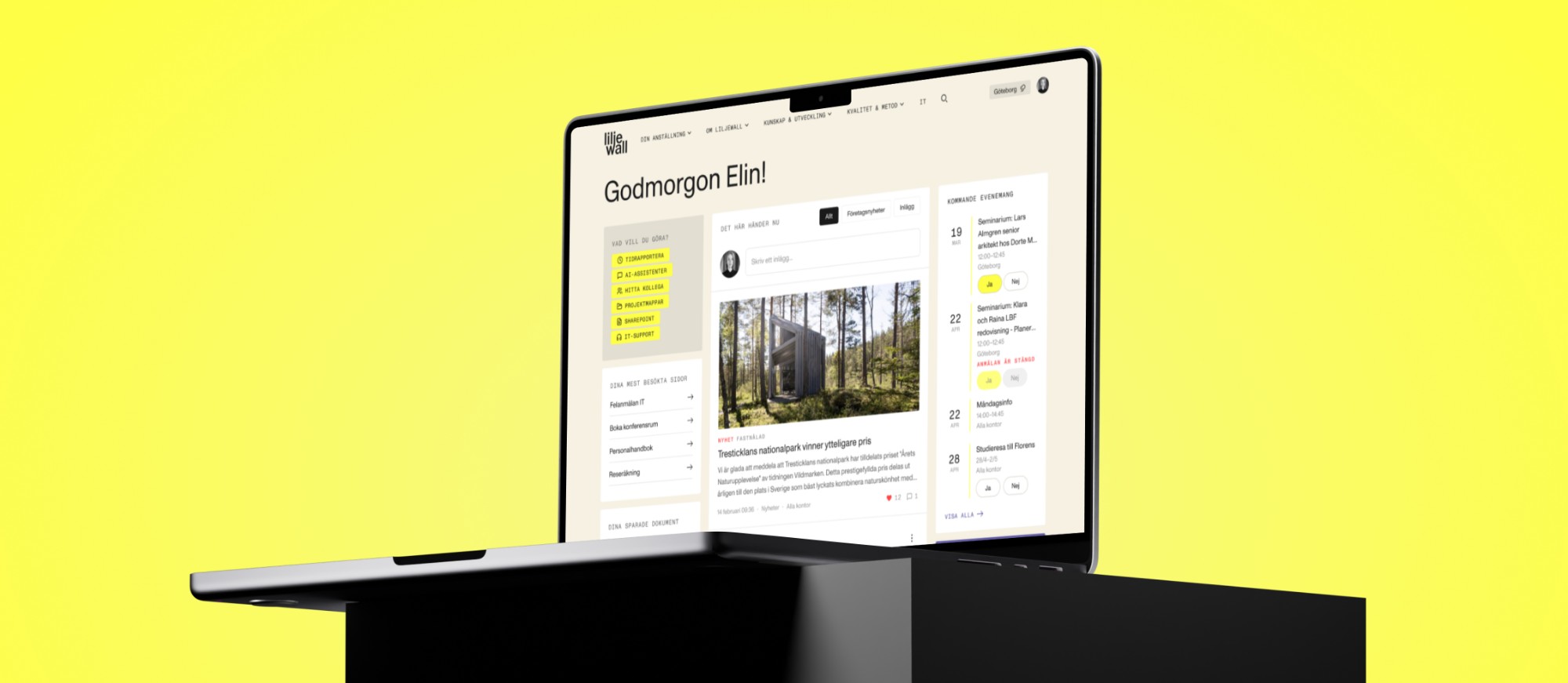
Search was what came up most often in the interviews, and in the concept it became a main entry point rather than a box in the corner. The AI search understands intent, not just exact words, so someone who types "where is the holiday request form?" and someone who types "holiday request" end up in the same place. It searches the content of PDFs and not just their file names, handles synonyms and can be filtered. The principle was that the intranet should work just as well for people used to clicking their way around as for those who would rather ask.
A place for what's happening
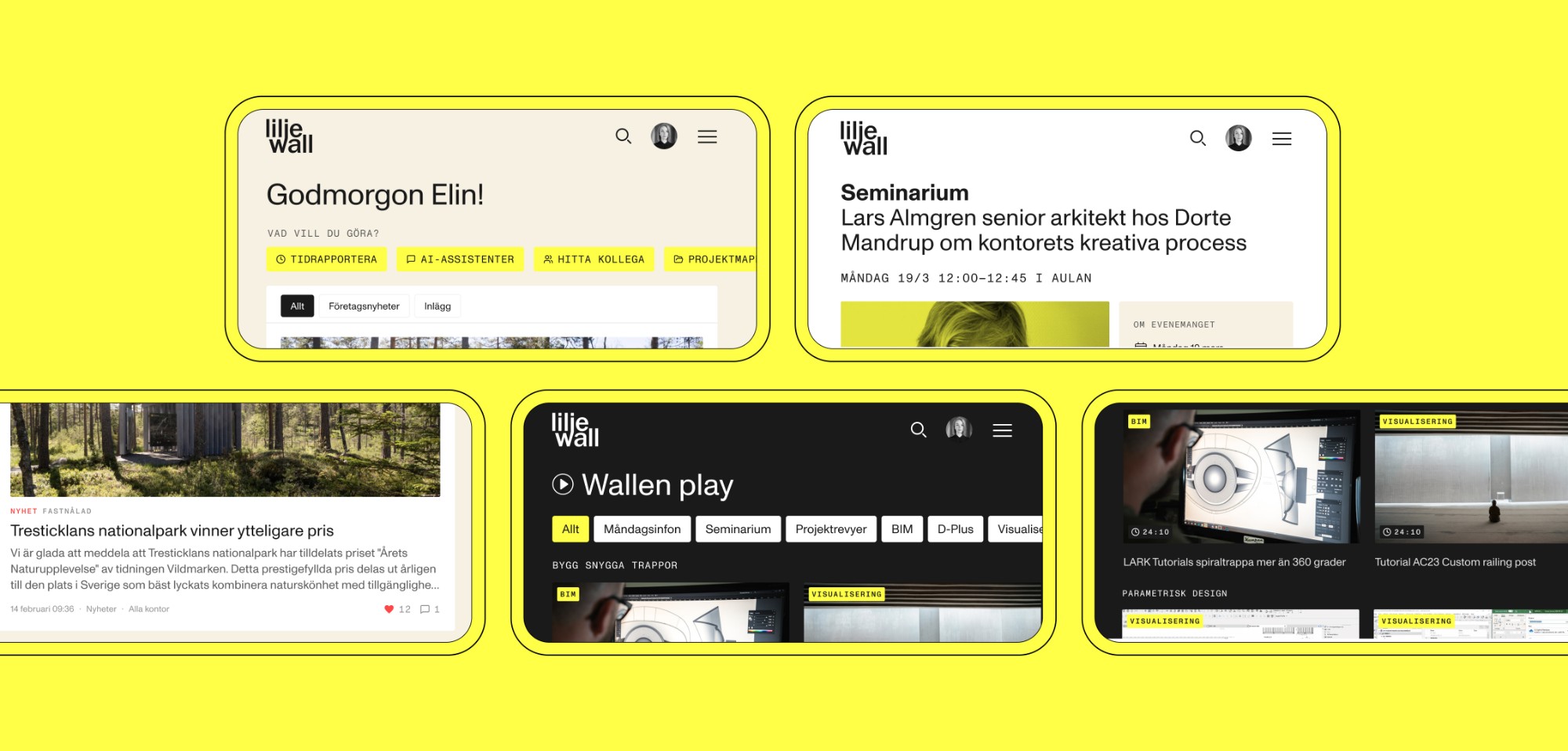
The start page mixes what you need with what is going on. A feed gathers news, events, tips and updates from across the intranet, and because the sign-in knows which office and role you have, content can be targeted. What only concerns Malmö reaches Malmö, without having to compete with what concerns everyone.
A forum was never the goal. The interviews showed that discussion threads die quickly at Liljewall, so the feed carries the culture instead: seminars, inspiration talks and colleagues' posts in the same place as the practical things.
The Academy
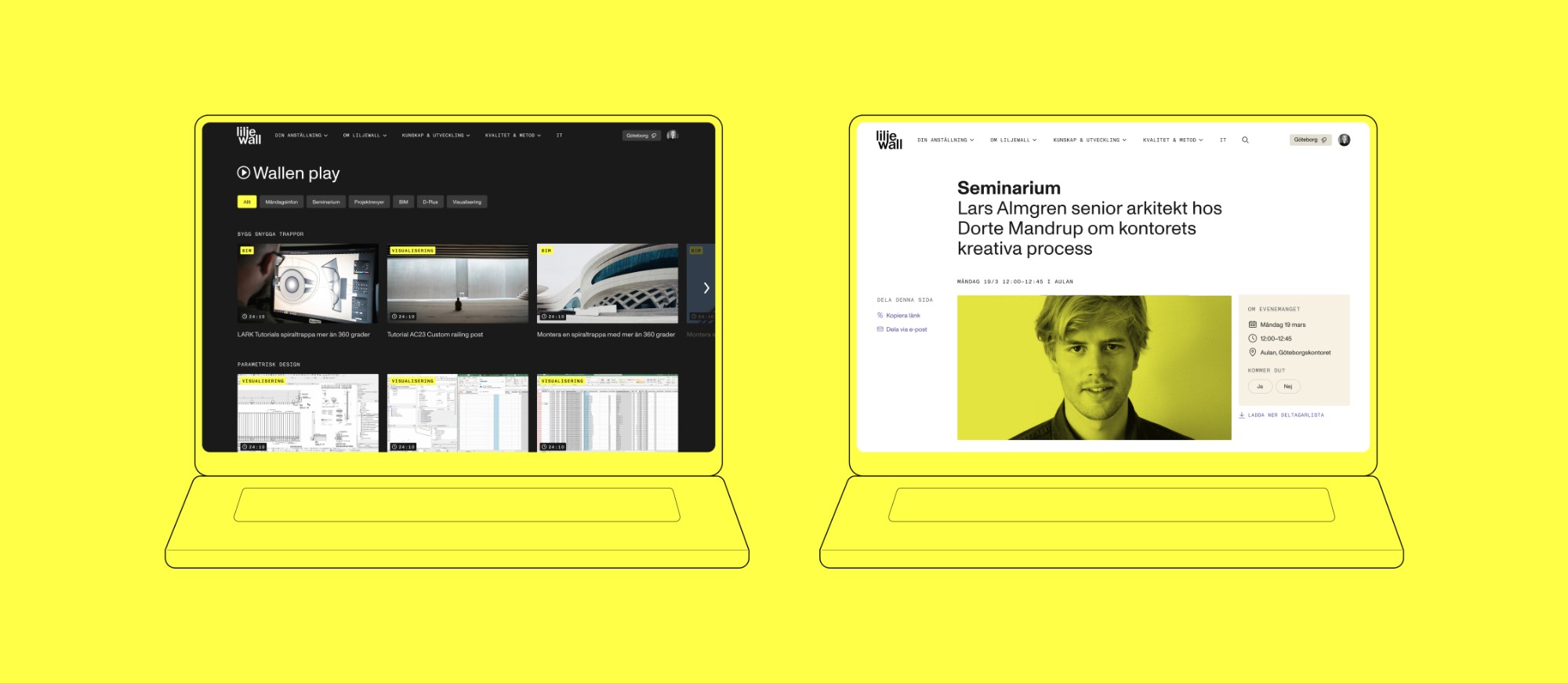
Liljewall has built up a great deal of knowledge in the form of training: recorded walkthroughs of the tools the architects work in, filmed internal courses, presentations and guides. Much of it sat deep in the old intranet or outside it, and the courses filmed every term had no obvious home. In the interviews, it was described as material that simply disappeared.
The Academy now gathers all training and continuing education in one place. Videos stored in SharePoint play directly on the page, and everything can be found through the AI search. Anyone wondering how something is done should be able to land on the right walkthrough without first knowing it exists. That makes the Academy part of everyday work rather than an archive you have to remember to visit.
From concept to launch
The design built on what already worked: clear headings and a form that is calm where it should be calm and has energy where it is needed. It follows Liljewall's visual identity, in a more readable version than the public website, and works just as well on a phone as at a desk.
The build took place in February and March 2026 and ended with acceptance testing, in which employees went through the intranet area by area following test scripts. Faults were found by the people who would be maintaining the solution. Up to launch, Liljewall produced the content while we built complementary features in parallel.
Staffing deliberately shifted between the phases. The pre-study was carried out by business development, service design and interaction design without a single developer, because its job was to clarify needs, not solutions. Developers only came in once the direction had been chosen and the technology tested.
Result
The intranet launched in June 2026 and is in operation. The solution is built on a headless architecture with WordPress and Next.js, reusing the existing sign-in and SharePoint, and is developed further from a prioritised backlog.
The strongest proof of quality is that the pre-study's recommendations are what was built. The analysis held when it met reality a year later. The second is that we twice advised against the larger solution, first the integrated platform and then a fully custom-built one.
Conclusion
The hardest thing about an intranet that already works is knowing what not to touch. The second hardest is realising that what looks like a navigation problem is often a maintenance problem. What we take away from Liljewall is how much a build phase of a few months rests on the weeks spent framing the question properly.