Hyph: music creation for a new generation
From hand-drawn sketches to a global launch and a 4.8 rating on the App Store. Äventyret shaped the interface and the way of working that carried Hyph there.
Hyph set out to make creating music as easy as sending a message. That took an interface able to hide the complexity of music production, and a way of working that could hold a fast-growing team together. Äventyret took on both, all the way to launch on the App Store and Google Play.
About Hyph
Hyph is a music platform where anyone can create, remix and share music straight from their phone, whatever their musical background. The company was founded in the US with Swedish roots, and behind the venture is, among others, Andreas Carlsson, one of Sweden's most established songwriters. At its core is a library of stems — the individual recorded tracks that make up a song: beats, guitars, bass, vocals and percussion. The rights are settled in advance, so almost everything in the library is free to build on.
The challenge
The brief arrived by plane from San Francisco, as hand-drawn lo-fi sketches. The ambition behind them was considerable: creating music should feel as easy as sending a message, both for someone who has never opened a music program and for someone who has spent twenty years inside one.
That is a harder promise than it sounds. Music production rests on concepts and decisions that take years to learn, and all of it had to stay in the product without taking up room in the interface. Hyph was growing quickly at the same time, with teams on both sides of the Atlantic, which made it important that decisions could keep pace with the design.
Two deliveries, one result:
The complete UX/UI design
User journeys, interaction flows and every interface component, shaped so that a first-time user gets something that sounds good within a minute.
An innovation process for a newly formed team
A shared way of working with clear roles and stated decision points, so product, design and development could move from idea to decision without getting tangled in each other.
The interface: hide the complex, lift the playful
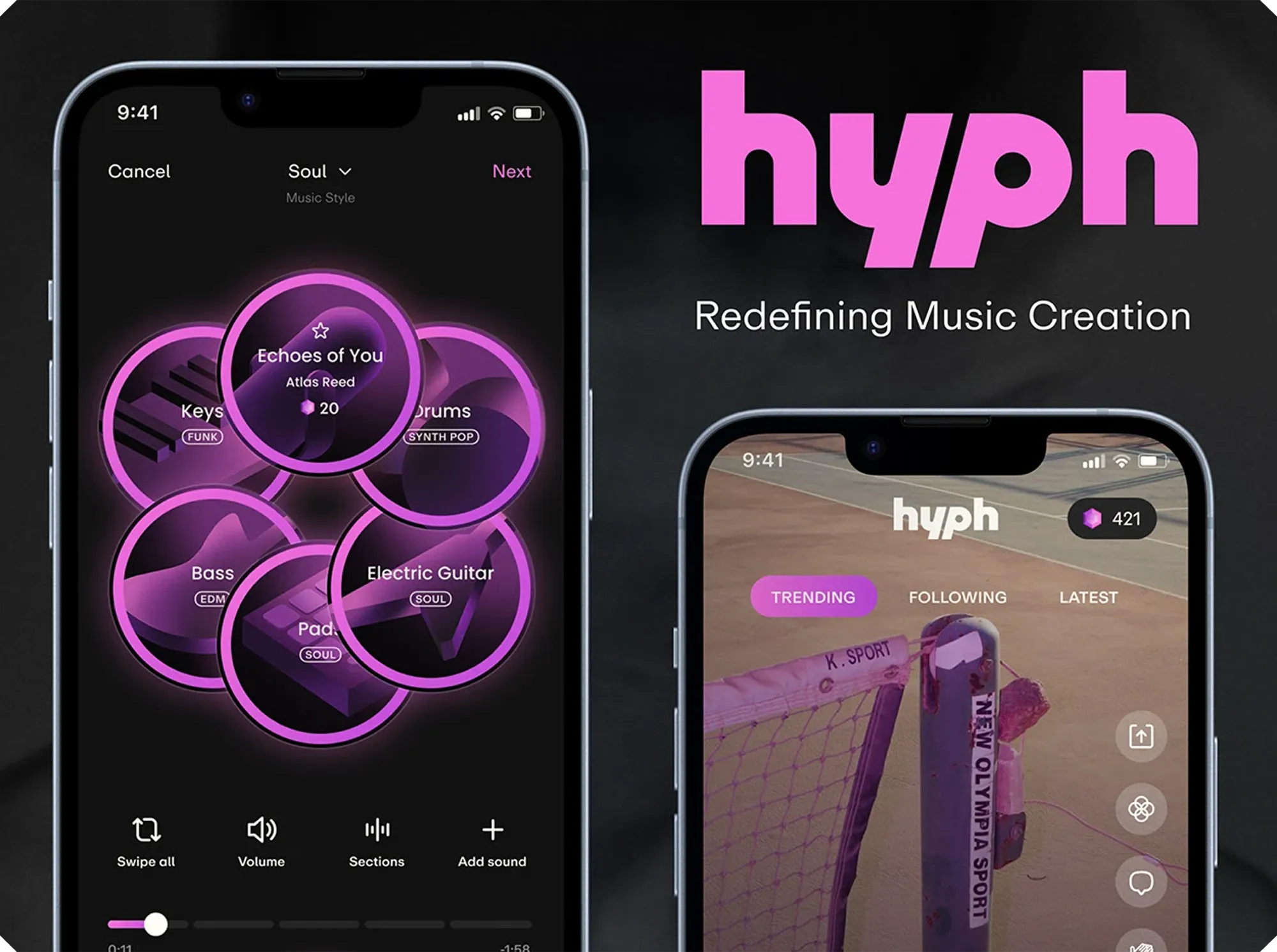
Music production is full of concepts and decisions that put off anyone new to it. Design work therefore began in the user journeys, with three questions for every step: what should feel obvious, what may take a moment, and what should never be seen at all? The answers became an interface where the components feel more like toys than tools, while still carrying the functionality an experienced creator needs. Underneath it all sits a simple rule: whatever you do in Hyph should sound good. Swap out a stem and it adapts to the key.
In practice, that means Hyph does not open on a timeline full of controls, as most music tools do. It opens on four sound rings, one per stem, that you touch directly: layer them, or swipe to swap one out. Levels, reverb and delay sit one tap away for anyone who wants to go further, but nobody needs them to get started. Play first, produce later became a principle for the whole app. If you want your own voice over the track, you record it in the same view.
Designed to come back to
Once the flow for making a track was in place, the work moved on to what you do with it afterwards. A track is meant to be heard, so it can be shared straight to social media, with the aim of getting the music out of the app as quickly as possible. Inside the app it lands in a feed where others can listen, like and remix it further, so one track becomes the start of the next.
To bring people back, new challenges arrive every week, such as "make a hip-hop version of this ballad". The challenges are tied to achievements: take part in five and earn Spins, the app's own currency. A leaderboard that resets every week and levels that unlock new sounds keep the same loop going.
A marketplace both sides can trust
Real artist vocals are what lift a track in Hyph, and around them we developed a complete gamification strategy. You earn Spins by creating and taking part in challenges, and spend them to unlock premium vocals and other premium features. Anyone who would rather get going straight away can buy a pass of Spins. The price is visible before you unlock, and whatever you unlock you own for good.
Artists get paid for their voices. For them, we also built a subscription that gives access to the whole stem library, to use in the desktop tools they already work in.
The process: structure that enables pace
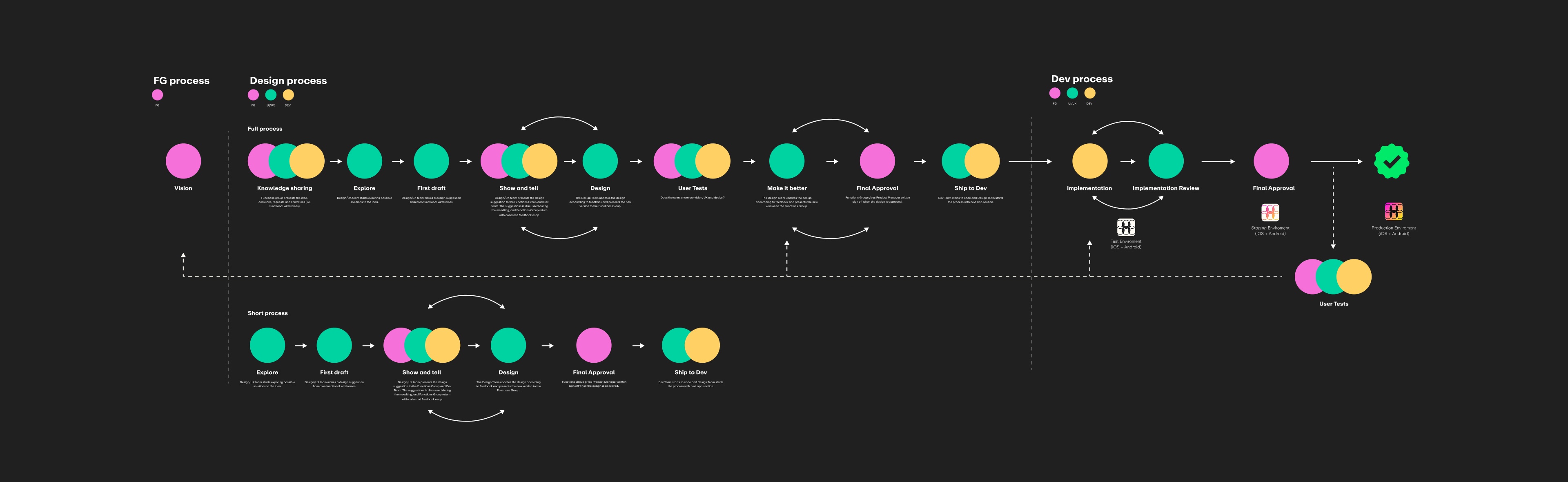
Alongside the design, we took the role of process leaders and set a shared method for how Hyph would work from idea to product. It rests on two tracks: a long one for the big decisions, a short one for quick iterations, so nobody had to guess what kind of question was on the table.
Result
Hyph launched globally in spring 2025 on both iOS and Android. We were there all the way to launch and kept iterating on the product for a period afterwards. Six months after launch, the app held a 4.8 rating on the App Store.
What we are most pleased with is not really the launch but what came after: the process stayed. It is still the backbone of how the team makes decisions about the product.
Try Hyph
Download the app and hear how far you get in a minute.

Andreas Carlsson
Chief Music Officer, Hyph
Conclusion
What we take away from Hyph is how much work it takes to make something feel easy. Every decision about what to leave out of the interface was, at bottom, a decision about who the product is for. Setting the way of working alongside it made those decisions easier to hold on to, but it was in the interface that they showed.

Do you love music and interfaces too?
Get in touch and I'll tell you more about how we worked with Hyph.